White
light, or most kinds of light that we use for illumination
including our sun, contains all the colors in the visible spectrum,
in varying degrees of proportions depending on the light source.
For example, a typical incandescent household light bulb gives off
more red light than a common office fluorescent light, which usually
produces more bluish light. A full-spectrum light simulates the
full range of light found in sunlight.
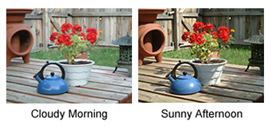 Even
sunlight falling on objects at different times of day can make them
appear to have color shifts. The same object can appear differently
in morning sun than at noon, and different still at sunset. However,
the human eye and brain tend to compensate for this color shift,
interpreting colors of objects consistently in varying lightings.
The camera shows the difference. Even
sunlight falling on objects at different times of day can make them
appear to have color shifts. The same object can appear differently
in morning sun than at noon, and different still at sunset. However,
the human eye and brain tend to compensate for this color shift,
interpreting colors of objects consistently in varying lightings.
The camera shows the difference.
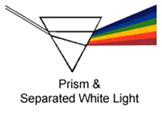
When
white light is passed through an object that bends or refracts
it, the individual spectral hues in the light spread
and separate at individual angles as they emerge from the refracting
object. The historic scientist Isaac Newton was aware in the late
1600's that if white light was passed through a glass prism,
distinct bands of separated colors could be observed, when projected
onto a white surface.
 Newton
discovered that if the separated spectrum of colors was then passed
through a second prism, the refracted hues could be recombined to
emerge as white light once again. His findings disproved the prevailing
belief of his time that the prism added the colors, sparking much
debate about the nature of light and color. Newton
discovered that if the separated spectrum of colors was then passed
through a second prism, the refracted hues could be recombined to
emerge as white light once again. His findings disproved the prevailing
belief of his time that the prism added the colors, sparking much
debate about the nature of light and color.
 The
prism effect can be seen when we look at a rainbow,
which contains the spectral hues refracted through water droplets
in the atmosphere. Two people standing next to one another will
likely see the refraction from different droplets of water, creating
a separate rainbow for each of them. Since the violet wavelengths
are shorter, a primary rainbow will always have violet on the inside
(inner arc) and red on the outside. Dimmer secondary rainbows caused
by another refraction inside the water droplets may also be visible,
appearing with their colors reversed. The
prism effect can be seen when we look at a rainbow,
which contains the spectral hues refracted through water droplets
in the atmosphere. Two people standing next to one another will
likely see the refraction from different droplets of water, creating
a separate rainbow for each of them. Since the violet wavelengths
are shorter, a primary rainbow will always have violet on the inside
(inner arc) and red on the outside. Dimmer secondary rainbows caused
by another refraction inside the water droplets may also be visible,
appearing with their colors reversed.
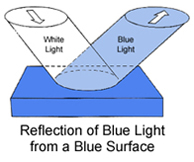 When
white light strikes a colored surface, the surface absorbs
all the spectral hues except those that are contained in the pigment
or surface color of the object, which are reflected.
For example, when light falls on a red tomato, its surface will
absorb all colors except the red, which is reflected back. This
is why the tomato appears red to a human eye. If the light falls
on a blue table, the surface absorbs all colors except blue, which
is reflected back for us to see. When
white light strikes a colored surface, the surface absorbs
all the spectral hues except those that are contained in the pigment
or surface color of the object, which are reflected.
For example, when light falls on a red tomato, its surface will
absorb all colors except the red, which is reflected back. This
is why the tomato appears red to a human eye. If the light falls
on a blue table, the surface absorbs all colors except blue, which
is reflected back for us to see.
Click
Next to take the Color Science Quiz!
|