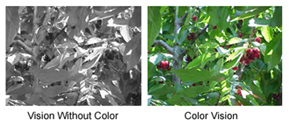
 Color
vision has reached a high level in primates, especially humans.
While survival today may not depend on whether an individual can
see colors, our ancestors who evolved to perceive a full range of
colors could better spot food and predators, giving them a distinct
advantage over those whose color perception was less robust. Humans
can perceive colors in the millions, by some estimates up
to 10 million different colors. Color
vision has reached a high level in primates, especially humans.
While survival today may not depend on whether an individual can
see colors, our ancestors who evolved to perceive a full range of
colors could better spot food and predators, giving them a distinct
advantage over those whose color perception was less robust. Humans
can perceive colors in the millions, by some estimates up
to 10 million different colors.
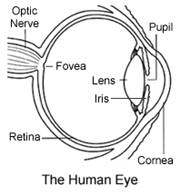
The
human eye consists of an outer cornea, covering
the iris, which expands and contracts to dilate
the pupil and control the amount of light entering
the eye. Beyond the iris is the lens, which refracts
light and projects a reduced, inverted image onto the retina
lining the back of the eye. Although the image projected onto the
retina is inverted, or upside down, we have evolved to automatically
compensate in our brains so that what we see corresponds with our
other senses in our physical world.
 The
retina consists of photoreceptor cells that translate
light's electromagnetic radiation into packets of nerve impulses
that are sent to the brain via the optic nerve.
These impulses stimulate the brain to perceive colors. The cerebral
cortex, the most highly evolved part of the brain, processes
visual information and combines it with memory and associations
to produce each individual's unique visual sensation. The
retina consists of photoreceptor cells that translate
light's electromagnetic radiation into packets of nerve impulses
that are sent to the brain via the optic nerve.
These impulses stimulate the brain to perceive colors. The cerebral
cortex, the most highly evolved part of the brain, processes
visual information and combines it with memory and associations
to produce each individual's unique visual sensation.
The
optic disc immediately over the optic nerve channel
to the brain contains no photoreceptors at all, causing a small
blind spot, but our vision compensates for this since we move our
eyes frequently.
The
retina's photoreceptor cells consist of rods and
cones. Both rods and cones contain photopigments,
which generate the electrical signals sent to the brain.
Rods
help us to see in scotopic low light settings,
and perceive differences in lightness and darkness only, or differences
in grayscale value. Rods contain a photopigment called rhodopsin,
which bleaches in the presence of light, a reversible process, but
one that causes temporary visual impairment known as dark
adaption when entering a dark area from a light one.
Light
must be present for humans to perceive color. In a completely dark
setting, where no light can enter, the eye cannot perceive anything.
In a darkened room, where only outlines of objects can be seen,
these objects are visible because there is still a low level of
light present in the room, although it may not be enough light to
allow colors to be seen.
Cones
in general are more sensitive to longer wavelengths, or red light,
while rods are more sensitive to shorter or blue wavelengths. This
means that in high light levels, a red object may appear brighter
than a blue one, while in low light levels where values are perceived
more than hues, the same blue object may appear to be the brighter
one. This phenomenon is known as the Purkinje shift,
after the Czechoslovakian physiologist Johannes Purkinje, who discovered
it in the 1800's.
|