| |
Colors
that are found in the visible spectrum are the colors of light.
The three primary colors of light are theoretically
red, green, and blue, although in practice they actually appear
closer to red/orange, green, and blue/violet. Primary colors are
the colors that cannot be created by mixing other colors, and theoretically
from which all other colors are mixed. For the purpose of this program,
I will refer to the primaries of light as red, green, and blue,
or RGB. When these three primary colors of light
are overlapped, the result is white light.
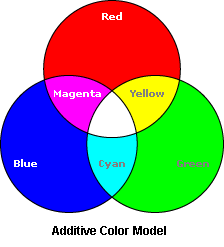 When
two of these primary light colors are overlapped, the resulting
light forms a new color, different from the original two and lighter
than either of them. These resulting colors are known as secondary
colors. Combining the correct proportion of red and green
light produces yellow light, mixing green and blue light produces
cyan, and a combination of red and blue light produces magenta. When
two of these primary light colors are overlapped, the resulting
light forms a new color, different from the original two and lighter
than either of them. These resulting colors are known as secondary
colors. Combining the correct proportion of red and green
light produces yellow light, mixing green and blue light produces
cyan, and a combination of red and blue light produces magenta.
This
process of combining two colors of light to produce a new secondary
color, or of combining all three light primaries to produce white
light, is known as additive mixing.
Colors that are seen on a television screen, video display, or a
computer monitor, or recorded by a scanner or film recorder, are
the result of additive mixing of RGB color.
 The
three primary RGB colors are mixed using tiny dots or cells on the
screen, and the resulting combination of dots makes up the image
that is displayed. In a computer program, the user is typically
offered a selection of colors to choose from, or is allowed to mix
their own colors. When desiring color consistency across a majority
of monitors, using colors in the 216-color Web Safe palette
ensures colors will remain consistent on different monitors, even
older ones. Some designers are beginning to use a larger palette
of 4,096 colors called the Web Smart palette, which
assumes that most users will view pages on recent model monitors. The
three primary RGB colors are mixed using tiny dots or cells on the
screen, and the resulting combination of dots makes up the image
that is displayed. In a computer program, the user is typically
offered a selection of colors to choose from, or is allowed to mix
their own colors. When desiring color consistency across a majority
of monitors, using colors in the 216-color Web Safe palette
ensures colors will remain consistent on different monitors, even
older ones. Some designers are beginning to use a larger palette
of 4,096 colors called the Web Smart palette, which
assumes that most users will view pages on recent model monitors.
Another
way of looking at the secondary colors is to consider them the result
of one of the primaries subtracted from white light. Cyan is white
light with red light subtracted, magenta is white light with green
light subtracted, and yellow is white light with blue light subtracted.
These colors, cyan, magenta, and yellow (CMY) are used in what is
known as the subtractive mixing process, discussed
on the next page.
|
|