| |
As
discussed on the previous page, the three secondary colors
produced by mixing any two primary colors of light form cyan, magenta,
and yellow (CMY), otherwise known as the subtractive
colors, or colors used in the subtractive mixing
process.
The
subtractive process is used in mixing printing inks, as well as
dyes, paints, plastics, or other physical materials in which pigments
are mixed with a base material.
Mixing
pigments results in a subtraction of the reflected light from a
surface. This is because when pigments are mixed to form another
color, the resulting color combines the absorption characteristics
of both colors, and is darker rather than lighter. More of the colors'
wavelengths are absorbed in the mixed color than in either original
color, and not reflected back to the eye.
Combining
two of the subtractive colors by mixing pigments theoretically should
produce one of the primary colors of light: red, blue, or green
(RBG). In theory, a combination of cyan and magenta
pigments should produce blue, magenta and yellow pigments should
produce red, and cyan and yellow pigments should combine to produce
green. However, the pigments used to make the colors are typically
not pure, resulting in dull colors that are not what theory would
suggest. This problem is compensated for by adjusting the proportions
of pigments mixed to produce the desired color.
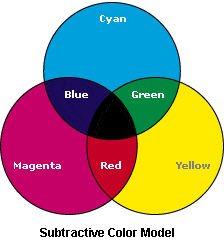 When
cyan, magenta, and yellow are combined, they theoretically form
black. In practice, however, the impure nature of pigments used
to make the colors results in a dull brown or gray. An additional
pigment, black (K), is added to ensure the combination appears as
a true black and to deepen shadow areas. When
cyan, magenta, and yellow are combined, they theoretically form
black. In practice, however, the impure nature of pigments used
to make the colors results in a dull brown or gray. An additional
pigment, black (K), is added to ensure the combination appears as
a true black and to deepen shadow areas.
Subtractive
color mixing is used in the 4-color printing process,
consisting of inks in the colors cyan, magenta, yellow, and black
(CMYK). The four colors are printed onto a surface,
usually white or a light color. Many desktop printers also use this
model to reproduce colors on a surface.
When
we view the final printed piece, the light from the surface of the
material is reflected back to the eye through the layers of pigments
that have been applied to the surface. Each layer subtracts bandwidths
of light, and combines with the others to create an illusion of
multiple colors.
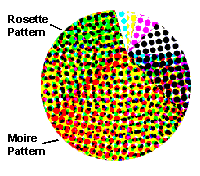 In
4-color process printing, the image is separated
into each of the four process colors. These color separations are
used to make plates for the presses to run each
ink color, one plate per color. The plates are screened into a pattern
of tiny dots, and the angles of each color plate are set differently,
to produce a pattern called a rosette, which gives
the illusion of color transitions. If any of the screened plates
are misaligned or out of register, a moire pattern,
a mottled and visually discontinuous appearance, results instead. In
4-color process printing, the image is separated
into each of the four process colors. These color separations are
used to make plates for the presses to run each
ink color, one plate per color. The plates are screened into a pattern
of tiny dots, and the angles of each color plate are set differently,
to produce a pattern called a rosette, which gives
the illusion of color transitions. If any of the screened plates
are misaligned or out of register, a moire pattern,
a mottled and visually discontinuous appearance, results instead.
Some
process printing methods use more than four colors, adding additional
ink colors into the process to increase the range of colors. Another
method, spot color printing, is different from
process printing because it involves applying solid layers of ink
in pre-mixed combinations of pigments that typically allow little
or no reflection of the surface. In this method, only the colors
from the flat layers of pre-mixed ink are reflected back. The background
surface is visible where no ink has been applied. This method is
often used for budget printing, or in combination with process printing,
to add a layer that most closely duplicates a specific color.
|
|