| |
To
understand the relationships between colors, they are typically
placed on a color wheel or color circle, with sections
shown in different colors, and with the colors arranged in the order
in which they appear in the visible spectrum. Color wheels are theoretical
diagrams of the structure of the visible spectrum, or some part
of it, and the relationships of one color to another. Another way
to think of the color wheel is to picture a thin strip of the visible
spectrum that contains the colors, and bend it into a circle to
form a wheel.
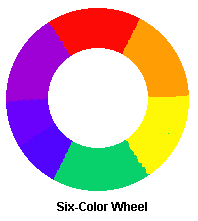 Color
wheels can contain varying numbers of colors, but usually contain
a number divisible by three, to show the relationship between three
colors and their intermediaries. They can also be constructed using
various color models, but the simplest way to demonstrate a color
wheel is by displaying the colors that most people associate with
the rainbow, and explaining the relationships between them. These
colors are usually thought to be six colors typically called red,
orange, yellow, green, blue, and violet
(sometimes called purple). Color
wheels can contain varying numbers of colors, but usually contain
a number divisible by three, to show the relationship between three
colors and their intermediaries. They can also be constructed using
various color models, but the simplest way to demonstrate a color
wheel is by displaying the colors that most people associate with
the rainbow, and explaining the relationships between them. These
colors are usually thought to be six colors typically called red,
orange, yellow, green, blue, and violet
(sometimes called purple).
The
color wheel shown above displays three primary colors
typically used in simple demonstrations of paint combinations: red,
yellow, and blue. This color wheel also includes secondary
colors between the primary colors: orange, green, and violet.
Most
people in the US consider these six colors to be the basic primary
and secondary colors, but in practice, science and industry use
different primary and secondary colors based on what products they
produce, and what color models they require. Module 4 in this program
will discuss more scientific and industry based color models.
 If
we include colors between all the primary and secondary colors on
this color wheel, we have a wheel now containing 12 colors. The
additional colors between the primary and secondary colors are known
as tertiary colors, and include such colors as
red/orange, yellow/green, and blue/violet. If
we include colors between all the primary and secondary colors on
this color wheel, we have a wheel now containing 12 colors. The
additional colors between the primary and secondary colors are known
as tertiary colors, and include such colors as
red/orange, yellow/green, and blue/violet.
Larger
color wheels are used as well, such as a 24-color wheel containing
intermediary colors red/red/orange, green/yellow/green, blue/violet/blue,
and others. There is theoretically no limit to the number of color
combinations that can be displayed in a color wheel, depending on
the variations of color desired. Color wheels such as these are
used for reference purposes in design, because our ability to match
colors from memory is much weaker than our ability to match colors
from a visual gradation system.
|
|