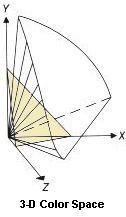
 A
color gamut describes the color space,
or range of colors, that a specific device or technology can use
or display. The color space is an imaginary 3-dimensional area that
encompasses all colors that device or technology can process. The
space is usually described by a system of coordinates to identify
the location of individual colors. A
color gamut describes the color space,
or range of colors, that a specific device or technology can use
or display. The color space is an imaginary 3-dimensional area that
encompasses all colors that device or technology can process. The
space is usually described by a system of coordinates to identify
the location of individual colors.
This
concept of color gamut or color space also includes the range of
colors that the human eye can perceive, and presumably the visible
ranges of other species as well.
Gamuts
for digital devices are specified by their manufacturers, and described
in a file known as a device profile. At each stage
of the design process, color output is dependent on the capabilities
or limitations of the specific device or technology being used.
Between
devices that can capture or display colors, there is a wide difference
in gamuts. The human eye can perceive more colors than a computer
monitor can display or that can be reproduced by the photographic
process. In general a computer monitor can display a wider range
of colors than can be reproduced on a printing press. Even two different
monitors or two different presses will have different gamuts. Disagreements
can result when a designer (or the designer's client) expect to
see on paper exactly what is displayed on their computer monitor.
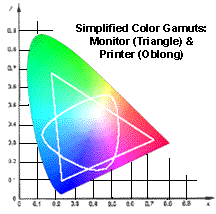 A
number of organizations worldwide have developed color matching
systems for ensuring more precise and consistent color results.
The Commission Internationale de l'Eclairage (CIE)
works with industry groups to develop specific, precise methods
and international standards for color matching. The CIE system uses
chromaticity diagrams such as the one shown to
the right to depict color spaces and map colors. A
number of organizations worldwide have developed color matching
systems for ensuring more precise and consistent color results.
The Commission Internationale de l'Eclairage (CIE)
works with industry groups to develop specific, precise methods
and international standards for color matching. The CIE system uses
chromaticity diagrams such as the one shown to
the right to depict color spaces and map colors.
Pantone,
Inc., widely used in the US, specifies a matching system
for standardized use in the printing industry. Pantone color swatches
in fan books and sample chips are tagged with numbers that represent
the proportions of CMYK inks to reproduce a process printed color,
or specific proportions of pigments that make up a spot color ink.
When a Pantone color is chosen, if the printer follows the correct
method the resulting printed color should closely match the sample
swatch, from one printed document to the next.
 Other
organizations such as the International Color Marketing
Group of the Color Association of the US specialize in
tracking and analyzing color trends, then predicting or forecasting
what colors will be in style for upcoming retail seasons. Their
results are published and used in a variety of industries to determine
color options available for products. Other
organizations such as the International Color Marketing
Group of the Color Association of the US specialize in
tracking and analyzing color trends, then predicting or forecasting
what colors will be in style for upcoming retail seasons. Their
results are published and used in a variety of industries to determine
color options available for products.
Click
Next to take the Color Models Quiz!
|